The Short Answer
Breathing well during exercise isn't complicated: keep breathing continuously, match your breath to your movement, and don't hold your breath. For cardio, breathe in a steady rhythm tied to your steps or pedal strokes. For lifting, exhale as you push the weight and inhale as you lower it. That's the whole system.
Why Breathing Makes Such a Difference
Most people breathe on autopilot until a workout gets hard, and that's exactly when breathing falls apart. Breaths turn short and panicky, shoulders creep up, the jaw clenches — and suddenly the exercise feels twice as hard as it should. The muscles aren't necessarily exhausted; they're just not getting a smooth supply of oxygen, and all that tension is doing nothing useful. Many people who think they're "bad at cardio" are really just bad at breathing during cardio — which is fixable much faster than most fitness goals.
The One Rule That Covers Everything
If you remember nothing else: keep breathing continuously through every movement. The most common mistake is holding your breath without realizing it — locking up, face red, everything tense. This happens most during hard reps of squats, push-ups, or deadlifts, and on the steep part of a hill.
Holding your breath under load briefly spikes your blood pressure — harmless for most people, but genuinely risky with a heart condition or high blood pressure. More immediately, it just makes everything harder: tension in your face and shoulders wastes energy your legs and back could use. If you catch yourself holding your breath, treat it as a signal to lighten the weight or slow the pace until breathing flows again.
Breathing for Cardio: Find Your Rhythm
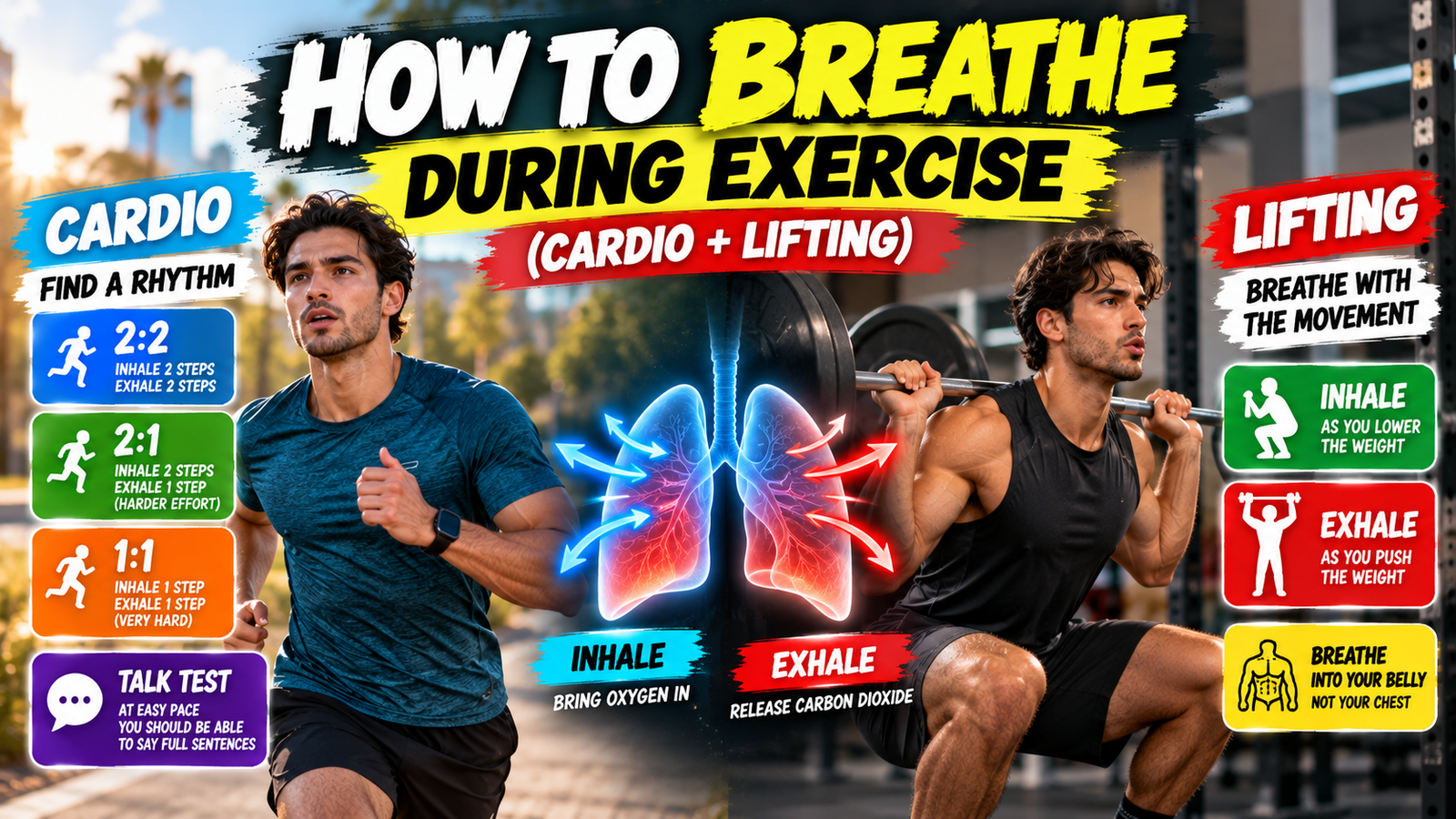
For running, cycling, rowing, or similar cardio, lock your breathing into a rhythm with your movement. For running, the classic pattern is 2:2: in for two steps, out for two — deep and even, instead of the frantic panting that usually takes over.
When you need to push harder — a hill, a faster interval — shorten the pattern to 2:1 or 1:1: inhale for two steps, exhale for one, or breathe in and out every step. The key is that it stays rhythmic. The moment your breathing breaks into random gasps, slow down until the rhythm returns. A steady rhythm at a slightly slower pace almost always beats a chaotic pace that forces you to stop.
Two checks keep your effort honest. The talk test: at an easy pace, you should manage full sentences. If you can only get out a few words, you're pushing too hard for a comfortable session. And if your shoulders creep toward your ears and your jaw clenches, you're breathing shallow — drop your shoulders, relax your face, and let the air go deeper.
Breathing for Lifting: Breathe With the Effort
The default pattern for lifting is simple: exhale on the hard part, inhale on the easy part. Push the weight up — exhale. Lower it — inhale. This works for push-ups, presses, squats, rows, and most machine exercises.
For heavier compound lifts, you'll hear about bracing: taking a big breath into your belly before the rep, tightening your midsection like you're about to be poked, and holding that tightness through the hardest part before exhaling. Bracing isn't the same as holding your breath casually — it's a deliberate technique that protects your spine. Beginners don't need it for light weights or machines. But if you start doing heavier barbell squats or deadlifts, learning to brace from a coach or trainer is worth the effort.
One cue fixes most shallow breathing: breathe into your belly, not your chest. Put a hand on your ribs and take a slow breath. If your hand moves outward and your stomach expands, your core is engaged and your ribcage is stable. If your shoulders lift and your chest puffs up, that's shallow breathing, and it'll make every rep feel harder than it needs to.
Nose vs. Mouth: The Honest Answer
You've probably heard that you should only breathe through your nose during exercise. The practical answer: nose breathing for easy effort, mouth breathing when intensity rises. At a comfortable jog, the nose keeps the air filtered and paced. But when your body demands more oxygen — hard intervals, heavy sets, a steep hill — your mouth will open naturally. That's your body doing its job, not a technique failure.
Use nose breathing as a pacing tool: if you can keep your mouth closed and still breathe comfortably, your effort is genuinely easy. If the air hunger gets strong enough that you need your mouth, open it and keep going. The only breathing method that's truly wrong is the one that stops.
Side Stitches and Getting Winded
If you get that sharp pain under your ribs when running — a side stitch — slow down and exhale fully, timing your exhale with the foot strike on the opposite side of the stitch: pain on your right, exhale as your left foot hits the ground. Stitches come back less often as your breathing rhythm gets steadier.
Getting winded fast doesn't necessarily mean you're unfit — it usually means you started too fast. Reduce the pace or load until your breathing rhythmizes again. Within two or three weeks of conscious practice, the patterns start running on autopilot.
A 5-Minute Practice Drill
Try this once and you'll feel the difference on your next workout:
- Minutes 1–2: Lie on your back, knees bent, one hand on your belly and one on your chest. Breathe in through your nose for four counts — the belly hand should rise more than the chest hand. Exhale for six counts.
- Minutes 3–4: Stand and do slow bodyweight squats. Inhale as you lower, exhale as you stand, and notice how the exhale helps you push up.
- Minute 5: Walk in place in a 2:2 rhythm — in for two steps, out for two. Speed up your steps while keeping the rhythm, and notice where it breaks.
The Bottom Line
Proper breathing comes down to three habits: breathe continuously, match your breath to the effort, and breathe deep instead of shallow. For cardio, that's a steady rhythm you can hold. For lifting, that's exhaling on the push and inhaling on the way down. Practice it consciously for a couple of weeks and it becomes as automatic as pedaling a bike.
This article is for general information only and isn't medical advice. If you have a health condition or injury, check with a qualified healthcare professional before starting a new exercise routine.