The short answer
Start with walking and a few simple bodyweight moves, two or three times a week, for about 20 minutes at a time. That's it. You don't need a gym, equipment, or a complicated program. The goal of the first two weeks isn't transformation; it's showing up regularly enough that exercise becomes something you do instead of something you dread.
First, drop the "completely out of shape" label
Nobody is keeping score of how out of shape you are. There is no entrance exam for exercise, and the starting line is exactly where you are right now. Most people who exercise regularly were terrible at it when they started — awkward, winded, sore in places they didn't know existed. The only difference between them and someone who never starts is that they were willing to be bad at it for a while.
It also helps to get honest about what "starting" means. Your first workout doesn't have to look like anyone else's. A 15-minute walk around the block where your heart rate goes up a little counts. Fitness is built from unremarkable sessions stacked over time, not from heroic efforts.
Your first two weeks: the actual plan
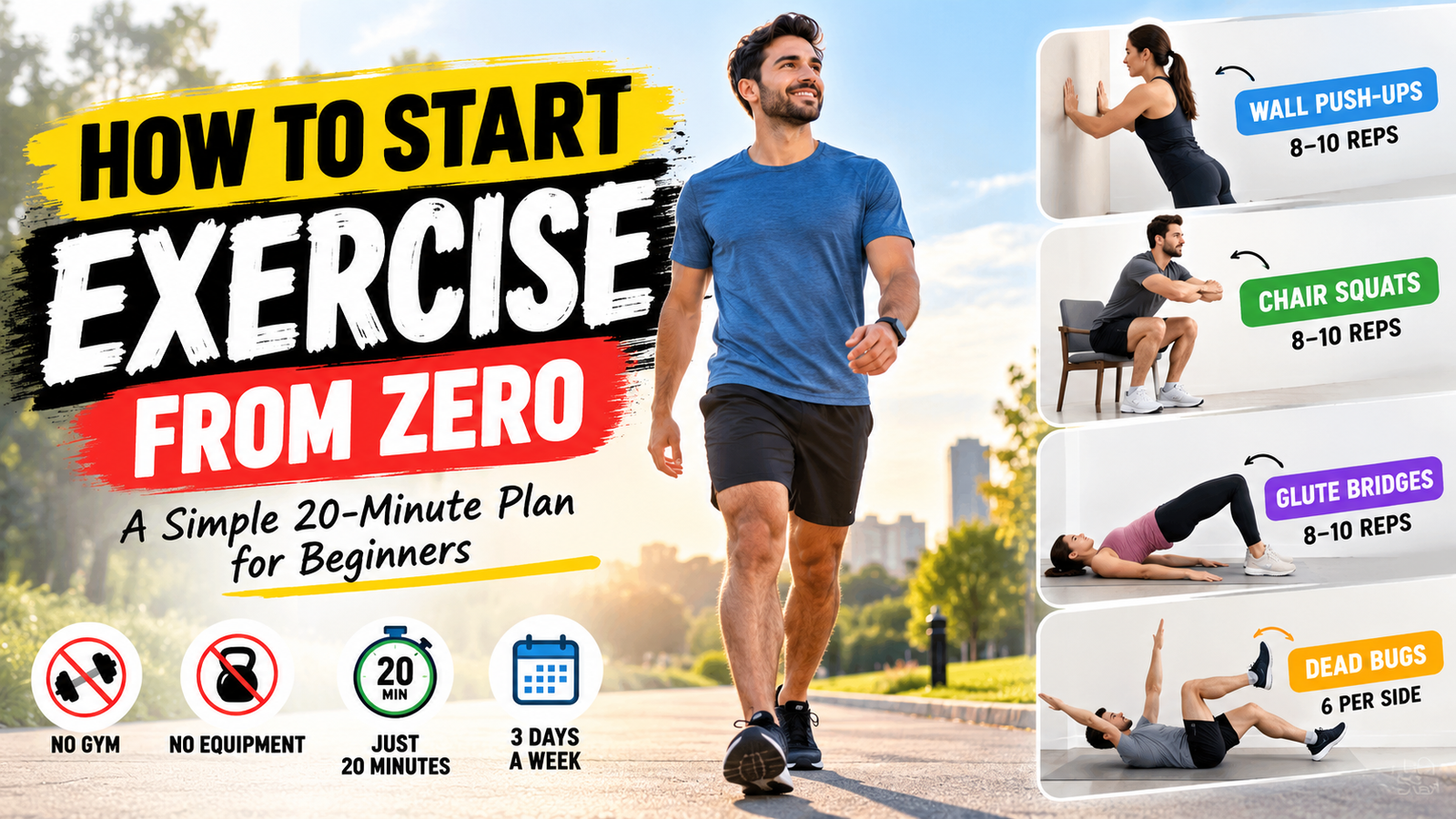
Here's a simple routine you can do at home, three days a week (Monday, Wednesday, Friday works well), with rest days in between. Each session takes about 20 minutes.
Part 1: Walk (10–15 minutes)
Walk at a pace that feels like you're going somewhere on purpose — not a stroll, not a sprint. If you can hold a conversation but you'd rather not sing, you're in the right zone. If 10 minutes feels like plenty, stop there.
Part 2: Four basic moves (2 rounds)
After your walk, do these four moves back to back, resting as long as you need between them, and go through the circuit twice.
- Wall push-ups (8–10 reps). Stand an arm's length from a wall, hands flat against it at shoulder height, and lower your chest toward the wall, then push back. If these feel easy, move your hands to a countertop or a sturdy table edge.
- Chair squats (8–10 reps). Stand in front of a sturdy chair, feet hip-width apart. Sit back slowly until your backside taps the chair, then stand up. Keep your weight in your heels and your chest up — the chair is your safety net.
- Glute bridges (8–10 reps). Lie on your back, knees bent, feet flat. Push through your heels and lift your hips until your body forms a straight line from shoulders to knees, squeeze for a second, then lower.
- Dead bugs (6 per side). On your back, arms reaching toward the ceiling, knees bent at 90 degrees. Slowly lower your right arm overhead and your left leg toward the floor, keeping your lower back pressed into the ground, then return and switch sides. Go slow — this is a core exercise, not a race.
That's the whole session. On your off days, take an easy 10-minute walk if you feel like it, or do nothing — rest days are part of the program, not a failure of it.
What the first two weeks will actually feel like
Fair warning, because nobody tells beginners this stuff:
- You'll be sore. Muscle soreness that peaks a day or two after a workout is completely normal at the start, and usually eases by the third week as your body adapts. Soreness is not injury — sharp, sudden, or one-sided pain means stop and get it checked.
- It will feel awkward. The dead bug will make you feel like a flipped turtle. This is the tax everyone pays, and it expires quickly — by week three, the moves will feel familiar.
- You won't see changes yet. Two weeks is enough to feel a little more energetic and a little less stiff, but visible changes take longer. The first month is about building the habit; the body follows.
- Some days you'll want to skip. Decide in advance what your minimum session is — the walk alone, even — so a low-motivation day becomes a short session instead of a skipped one.
Do you need a gym?
No. Everything above uses your body, a wall, a chair, and a floor. A gym becomes useful later, when you want heavier resistance or more variety.
If you do want to try a gym, know this: nobody is watching you. Experienced gym-goers are focused on their own workouts. Go during off-peak hours if a crowd makes you uneasy — mid-morning or early afternoon on weekdays is usually quietest.
How to make it past week three
Most people don't quit because the program is wrong — they quit because they did too much, got crushed by soreness or exhaustion, and decided exercise "isn't for them." The plan above is deliberately gentle to dodge that exact trap. Beyond that:
- Schedule it like an appointment. "Three times a week" is vague; "Monday, Wednesday, Friday at 7 AM" actually happens. Put it on your calendar.
- Track the streak, not the results. Mark an X on a calendar for every session you complete. After a few weeks, the row of X's becomes its own motivation.
- Lower the bar on bad days. A 10-minute walk when you planned 20 still counts as showing up. Consistency beats a perfect plan you abandoned.
- Expect week two to be the hardest. Week one runs on novelty. Week three runs on habit. Week two runs on nothing — and that's when most people quit. Knowing it's coming makes it easier to push through.
When to make it harder
After two or three weeks, you'll notice the moves getting easier — the wall push-ups feel light, you finish both rounds without much rest. That's your signal to level up slightly: move push-ups from the wall to a countertop, do three rounds instead of two, add five minutes to your walk, or slow each rep down. Change one thing at a time. The principle is simple — do a little more than last time — and it works for years.
The bottom line
Starting from zero doesn't require a dramatic transformation or a perfect plan. It requires 20 minutes, three times a week, of walking and basic movements — and the willingness to be a beginner for a little while. Everyone you see who's fit was once exactly where you are now. They just started anyway.
This article is for general information only and isn't medical advice. If you have a health condition or injury, check with a qualified healthcare professional before starting a new exercise routine.