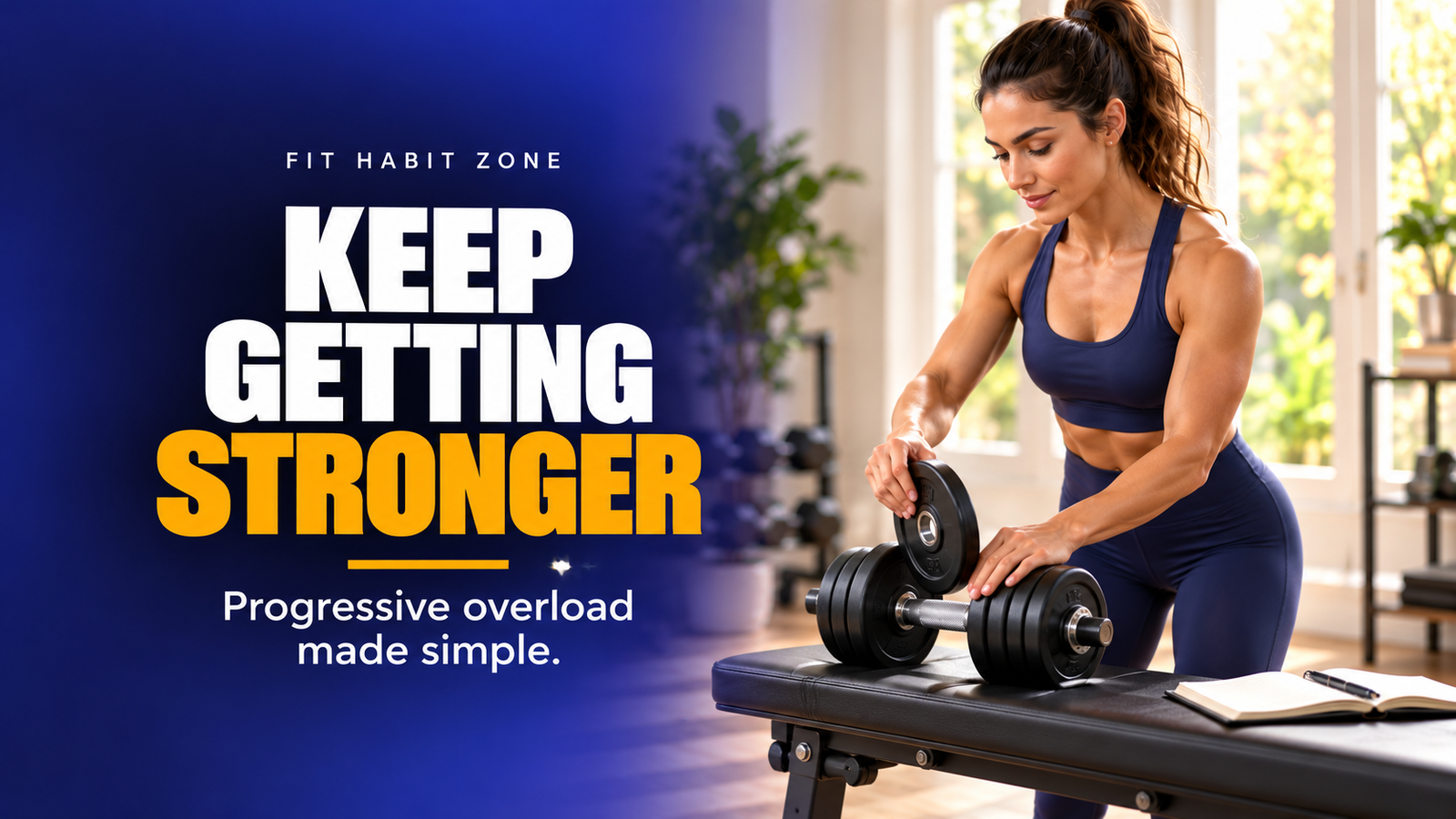
Here is the short answer: if you want to get stronger, you have to gradually make your workouts a little harder over time. That principle is called progressive overload, and it is the single most important idea in strength training. Without it, your body has no reason to change; with it, even a simple routine of basic lifts can keep producing results for years.
Most beginners stall because they repeat the exact same workout for months. Their body adapts to that workload in the first few weeks, and after that it just maintains.
What progressive overload actually means
Your body is efficient. It adapts to whatever stress you put on it, and no more. When you lift a weight that challenges your muscles, the body repairs the fibers a little stronger than before, so the same challenge feels easier next time.
Progressive overload means deliberately staying one small step ahead of that adaptation. Each week or two, raise the demand by a small amount, so your body keeps having a reason to adapt. The key word is small: adding five pounds is overload, adding fifty is an injury risk. The steadiest progress usually comes from the smallest increases, week after week.
Four ways to apply it
Adding weight is the most obvious method, but it is only one of four. When you cannot add weight, or when a lift gets stuck, the other three keep progress moving.
1. Add weight. If you squatted 95 pounds for 3 sets of 8 last week, try 100 pounds this week. For upper-body lifts, 2.5 to 5 pounds is plenty; for lower-body lifts, 5 to 10 pounds is realistic. Small fractional plates are worth owning, because they let you keep adding weight long after the big jumps get too hard. If you are still learning the basic lifts, our beginner strength-training guide covers the five movements worth building your routine around.
2. Add reps. If you cannot lift heavier yet, lift the same weight more times. Going from 3 sets of 8 to 3 sets of 10 on the same weight is real progress, and it is often how a plateau breaks. Once you can do all your sets at the top of your target rep range with good form, add weight next session and drop back to the bottom of the range.
3. Add sets. More total work is another form of overload. Moving from 3 sets to 4 sets increases the total volume your muscles handle, which drives growth. This is the easiest lever to pull when you train at home with limited weights, because it costs nothing. Just do not add sets forever: most people get the best return from 3 to 5 hard sets per exercise, and beyond that, fatigue eats into the quality of each set.
4. Improve range of motion and control. Squatting an inch deeper, lowering a push-up slowly instead of dropping, or pausing a second at the bottom of a rep all make the same weight harder. Taking three seconds to lower a weight, instead of one, increases the time your muscles spend under tension. This is a good option for bodyweight exercises, where you cannot simply grab a heavier dumbbell.
What a month of it looks like
Here is a concrete example with the goblet squat, holding a dumbbell at your chest. Week one: 3 sets of 8 with 25 pounds. Week two: 3 sets of 10 with the same weight. Week three: 4 sets of 10. Week four: 3 sets of 8 with 30 pounds. Weight, reps, and sets each took a turn, and you end the month lifting heavier, with no new equipment.
The same pattern works for any lift: push-ups, rows, deadlifts, overhead presses. Keep each exercise the same for at least four to six weeks, or progress becomes impossible to measure.
How to track it
You cannot progress what you do not record. A training log does not need to be fancy: a notes app, a small notebook, or a spreadsheet all work. For each exercise, write the weight, sets, and reps you did. Before your next session, look at the last entry and decide the one small increase you will make.
Here is the simplest version of a log entry: "Goblet squat — 25 lb, 3 x 10, felt strong, last set hard." That single line tells you exactly what to beat next time. After a few weeks, flipping back through the log shows, in plain numbers, how much stronger you have become.
Keep the focus on performance. The weights you lift are the most honest measure of progress, because they are not affected by water, lighting, or what you ate that day.
How often you train matters here as well. Most beginners do well lifting two or three days a week, which gives muscles time to recover. If you are unsure how to split that up, see our guide to how many days a week to lift weights.
Three mistakes that stall progress
Adding too much, too soon. Jumping from 135 to 185 pounds on a lift in one week does not speed up results. It usually wrecks your form, and bad form is how plateaus and injuries happen. If a weight forces you to cheat the movement, it is too heavy.
Skipping rest. Muscles do not grow during the workout; they grow during recovery. Training the same muscles hard every day without rest is one of the fastest ways to stall. If your numbers have stopped moving and you feel constantly tired, the problem may be too much training. Read why skipping rest days slows you down before adding a fourth or fifth lifting day.
Chasing soreness instead of progress. Soreness is not a reliable sign of a good workout; some of the most productive sessions leave you barely sore. Judge a workout by whether your log shows improvement over time, not by how stiff you feel the next morning.
The bottom line
Progressive overload is not complicated, and that is the point. Pick a few good exercises, do them consistently, and make them a little harder each week: a bit more weight, a few more reps, one more set, or a slower, deeper rep. Write it down, rest between sessions, and give the process a few months. The people who get strong are the ones who showed up and kept adding a little.
This article is for general information only and isn't medical advice. If you have a health condition or injury, check with a qualified healthcare professional before starting a new exercise routine.