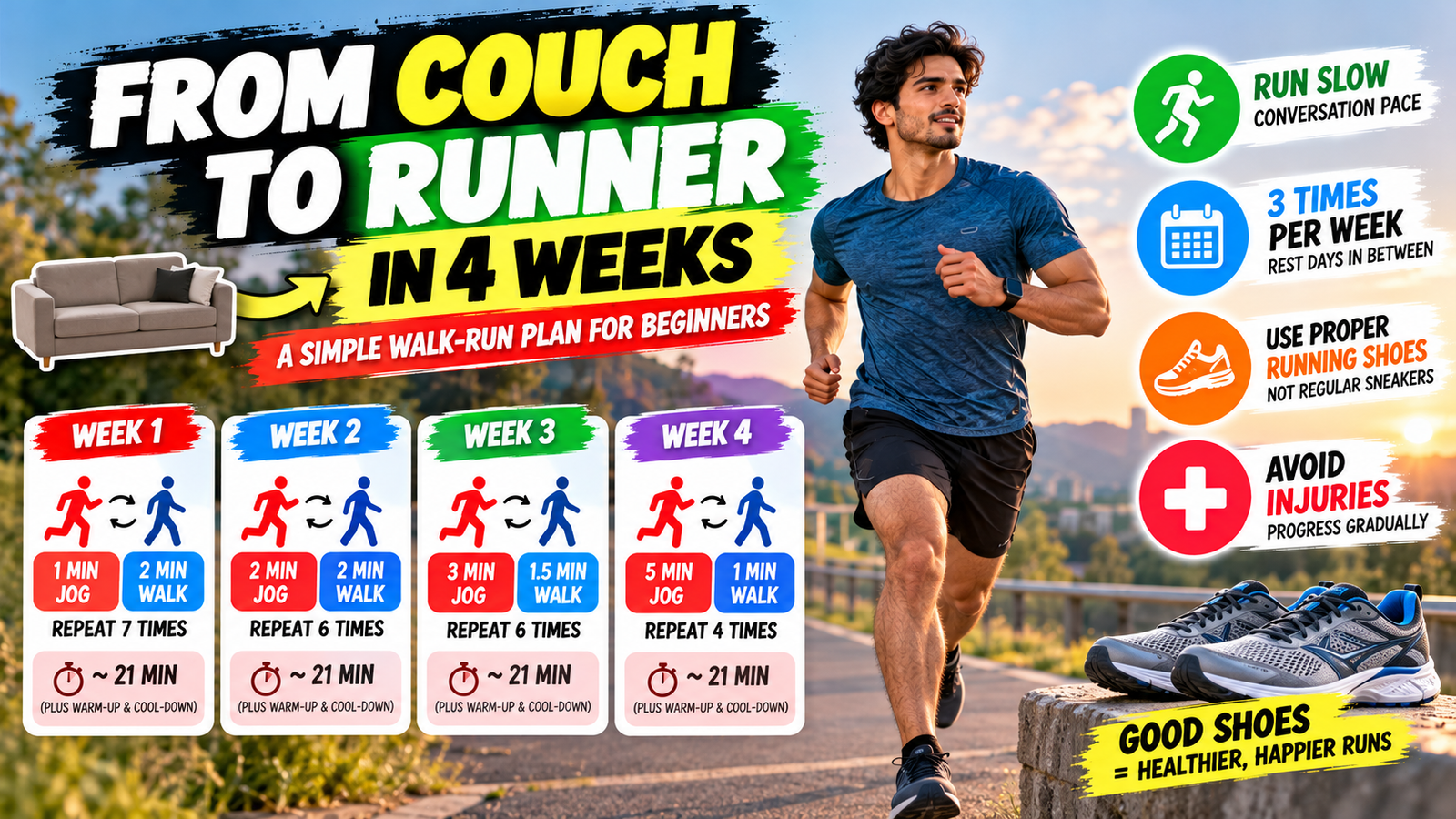

Can a complete beginner go from the couch to running a full 5K in eight weeks? Yes — if you build up with walk-run intervals instead of trying to run nonstop from day one. Three short sessions a week is enough for most healthy adults, no prior fitness base required. This plan takes you from one-minute jog intervals to jogging 30 minutes straight, which covers the 5K distance (3.1 miles) for most new runners. You don't have to race it — plenty of people walk portions of their first 5K and cross the finish line proud.
What you need before you start
Keep the equipment simple: shoes that fit and don't hurt, and clothes you can move in. Running-specific shoes help, but any supportive athletic shoe you already own is fine for the first few weeks. Skip the cotton T-shirt if you sweat a lot — it stays wet and cold — but don't buy a whole wardrobe before you've decided you like running.
Pick three days a week with at least one rest day between runs. If you feel sharp pain — not normal muscle tiredness, but pain — stop and walk home. That's not quitting; that's the single most important rule in this plan. Our couch-to-running walk-run guide covers the injury-avoidance basics in more detail if you want a deeper read on the early weeks.
The 8-week walk-run plan
Every session starts with a 5-minute brisk walk to warm up and ends with a 5-minute easy walk to cool down. The numbers below describe the main workout. Alternate running and walking for the stated intervals, repeated until you hit the total workout time.
- Week 1: Run 1 minute, walk 2 minutes. Total 20 minutes.
- Week 2: Run 1.5 minutes, walk 2 minutes. Total 20 minutes.
- Week 3: Run 2 minutes, walk 2 minutes. Total 25 minutes.
- Week 4: Run 3 minutes, walk 2 minutes. Total 25 minutes.
- Week 5: Run 5 minutes, walk 2 minutes. Total 30 minutes.
- Week 6: Run 8 minutes, walk 2 minutes. Total 30 minutes.
- Week 7: Run 15 minutes, walk 1 minute, run 15 minutes. Total 30 minutes.
- Week 8: Run 30 minutes without stopping. This is race week.
That's it. No speed work, no hill sprints, no GPS watch required. The run intervals grow while the walk breaks shrink, so your body adapts gradually instead of getting hit all at once. Notice that week 7 still includes one short walk break — that's deliberate. If you complete the week 7 sessions comfortably, running 30 minutes straight in week 8 is a small step, not a leap.
If a week feels too hard, repeat it before moving on. Adding an extra week is not failure; it's the plan adjusting to you. What breaks beginners is jumping ahead when the body hasn't caught up.
How to pace yourself: the talk test
Nearly every beginner runs too fast. "Too fast" doesn't mean sprinting — it means running just hard enough that you can't hold a conversation. The fix is the talk test: you should be able to speak in full sentences while running. Short choppy answers mean slow down. Full sentences mean you're in the right zone.
For the first four weeks, run at a pace that feels almost embarrassingly slow. Most beginners could "run" faster, and that's exactly the trap — running faster teaches your legs a pattern they can't sustain, and you end up walking from exhaustion instead of from the plan. Slow running is still running, and it's the pace that builds your aerobic base.
Pay attention to your breathing too. A steady rhythm — in through the nose and mouth, out the same way — keeps you relaxed. Holding your breath or breathing shallowly through the upper chest makes runs feel harder than they need to be. See our guide to breathing properly when you exercise for simple cues that apply directly to these walk-run sessions.
What to do on the non-running days
Rest days aren't empty days; they're when your body consolidates what the run sessions taught it. Tendons and bones adapt more slowly than muscles, which is why the rest days in this plan are non-negotiable — two sessions never land on back-to-back days.
If fatigue shows up as heavy legs that don't loosen up after ten minutes, treat it as information: take the extra day off. Our article on why rest days matter explains what recovery is actually doing behind the scenes.
Race-day tips for your first 5K
Most first 5Ks are local fun runs or charity events. Here's how to make the morning go smoothly:
- Eat something familiar. A light breakfast you've eaten before a run — oatmeal, a banana, toast — two hours ahead. Race morning is not the time to experiment with new food.
- Arrive early. Give yourself 30 to 45 minutes for parking, bib pickup, bathroom lines, and a short warm-up walk-jog.
- Start at the back. Faster runners line up front. Starting near the back means nobody sprints past you, and you'll pass plenty of people when you settle into your pace.
- Run your own race in the first mile. Adrenaline makes the first half-mile feel easy. Ignore it. Check that you can still talk in sentences at the first mile marker.
- Walk if you need to. Planned walk breaks aren't giving up — many experienced 5K runners use them strategically.
- Nothing new on race day. Same shoes, same clothes, same breakfast you used in training.
Mistakes that end beginners' plans early
The number one mistake is doing too much too soon — adding extra miles, skipping rest days, or racing a friend in week three. The second is wearing brand-new shoes on race day. The third is comparing your pace to anyone else's.
Missed a week? Don't try to make it up with double sessions. Just repeat the last week you completed fully and continue. Fitness decays far slower than people fear, and one missed week costs you almost nothing.
The finish line is just the start
Eight weeks from now, you'll be able to jog for 30 minutes straight — something most people assume they can't do. Pick your race at least a few weeks ahead so it's on the calendar, tell a friend you're doing it, and then just follow the weeks. The plan works if you work the plan, one slow conversational mile at a time.
This article is for general information only and isn't medical advice. If you have a health condition or injury, check with a qualified healthcare professional before starting a new exercise routine.