
Does sleep actually affect weight loss? Yes — and the connection is stronger than most people realize. People who sleep poorly night after night tend to eat more the next day, reach for heavier foods, and find it harder to stick with their routines. No amount of good sleep will melt fat on its own, and it certainly doesn't replace what you eat. But if you're doing everything right during the day and undermining yourself at night, fixing your sleep can be the change that finally makes the rest work.
What the research actually shows
For years, the link between sleep and weight was mostly observational: large studies found that people who habitually slept fewer hours tended to weigh more. Then a 2026 study from Columbia University, published in the Annals of Internal Medicine, tightened the evidence — adults who slept about 80 minutes less than their usual amount gained roughly a pound over six weeks compared to periods when they slept normally. One study isn't the whole story, but it's meaningful because it measured the same people sleeping more and sleeping less.
What science has not shown matters just as much. No study has shown that sleeping well, by itself, causes weight loss. The relationship runs through behavior: poor sleep makes the choices that lead to weight gain more likely. Think of sleep as a lever you pull alongside food and movement — not instead of them.
Why short sleep makes you hungrier
The connection runs through three channels, and you'll probably recognize all of them.
First, your appetite signals shift. After a bad night, the body's hunger signals get louder while the "I'm full" signals get quieter. The messaging system that tells your brain you've had enough just doesn't run as well on short sleep. The result isn't imaginary hunger — it's your body genuinely telling you to eat more.
Second, tired brains crave quick energy. When you're sleep-deprived, decision-making runs on fumes. The apple in your bag stops looking interesting and the vending machine starts looking reasonable. That's not a character flaw. It's fatigue doing its predictable work.
Third, short sleep creates long eating windows. Being awake for 18 or 19 hours instead of 16 means more hours when food is around, more evenings that end with snacks in front of a screen, and less patience for routines like meal prep. Sleep loss doesn't just change what you want — it changes how many chances you get to give in.
How much sleep do you actually need?
For most adults, the target is 7 to 9 hours — the range where research finds the fewest health problems, and where appetite signals behave best. Some people genuinely need less and some need more, but if you regularly run on 6 hours or fewer and your diet feels like a battle, sleep is a good suspect.
Consistency matters as much as duration. Sleeping five hours on weeknights and ten on weekends averages out on paper, but your body doesn't average it — it experiences five short nights and one groggy oversleep. Anchoring your wake-up time, even on weekends, does more for sleep quality than most people expect. It isn't about some magic hour; it's about giving your body's clock the same cue every day. That consistency-over-the-alarm-clock idea is the same reason the 5 AM rule itself is a myth — the schedule you can repeat beats the schedule that looks impressive.
7 small sleep habits that make weight loss easier
You don't need a sleep makeover. Pick two or three of these and run them for two weeks:
- Anchor your wake time. Get up at the same time every day, within about an hour. This single habit stabilizes your sleep drive more than anything you do at bedtime.
- Get daylight in the morning. A short walk in morning light tells your brain when "daytime" is, which makes "nighttime" come easier later. If you want one habit that pulls double duty, a morning walk covers both your light and your steps.
- Set a caffeine curfew. Coffee at 3 PM is still in your system at 10 PM. Try cutting caffeine after early afternoon and see if falling asleep gets easier.
- Dim the last hour. Bright overhead lights in the evening tell your brain it's daytime. Switch to lamps or dimmers after dinner — and stop scrolling in bed. The bed should belong to sleep.
- Keep it cool, dark, and quiet. A cool room and real darkness make sleep deeper. Blackout curtains or a sleep mask cost little and pay off fast.
- Build a wind-down. Ten to twenty minutes of reading, gentle stretching, or just sitting with tea signals the day is over. Screens and arguments don't qualify.
- Move the evening snack. Late-night grazing is often boredom plus fatigue. If you're truly hungry, eat something small and protein-rich; if you're just awake, go to bed instead.
What sleep can't do
Honesty check: improving your sleep will not fix a diet that's far off track, and it won't produce weight loss by itself. Some people sleep fine and still struggle — because weight management is mostly about what and how much you eat, with sleep as a supporting player. And remember the direction of the evidence: short sleep is linked to weight gain, which is not the same as proof that fixing sleep will reverse it for you personally.
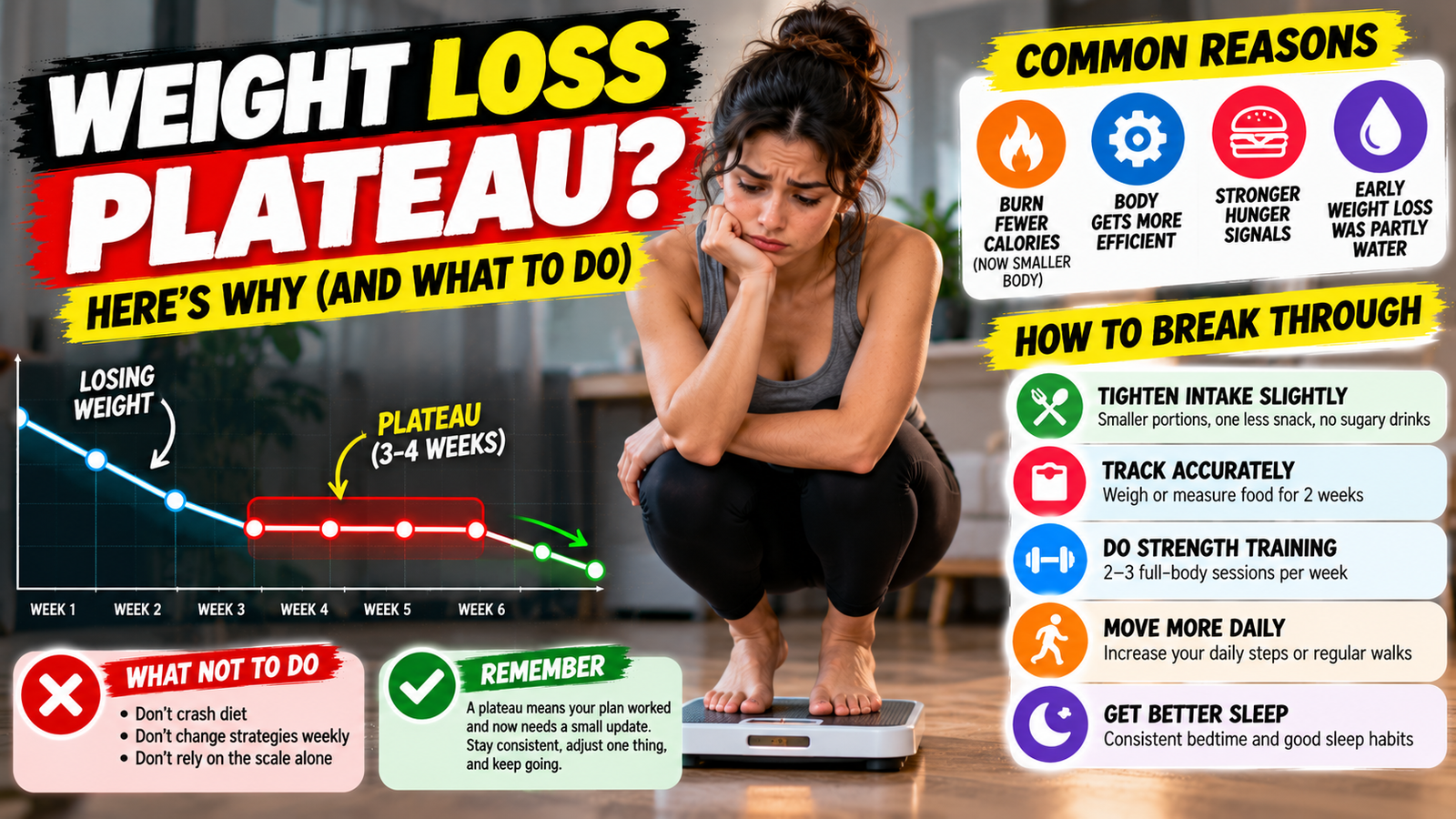
That said, if you've cleaned up your food, you're moving regularly, and the scale still won't budge, sleep is one of the first places to look. Poor sleep, hidden calories, and metabolic slowdown often travel together — check our guide to weight-loss plateaus for the full checklist, because the fix is usually a combination of small changes, not one magic lever.
The bottom line
Treat sleep like it's part of your plan — because it is. You track your steps and your meals; your bedtime deserves the same respect. Most adults need 7 to 9 hours, at a consistent time, in a cool dark room. That won't guarantee weight loss. But it will make hunger honest, cravings manageable, and every other good habit a little easier to keep. Nobody talks about sleep because it isn't exciting. The results are the exciting part.
This article is for general information only and isn't medical advice. If you have a health condition, an injury, or a possible sleep disorder, check with a qualified healthcare professional before changing your routine.