Here is the short answer: a habit sticks when it is small enough to do on a bad day, attached to something you already do, and easy to start. Most people fail at exercise habits not because they lack discipline, but because they build a routine that only works on a good day. Design for the bad day instead, and the good days take care of themselves.
Why willpower is the wrong tool
Willpower feels like the answer because it is what you notice on the days you succeed. You feel motivated, you push through, and it works. The problem is that motivation is unreliable. It dips when you sleep badly, when work runs long, or when life simply gets busy. A plan that depends on feeling motivated will break at exactly those moments, and one missed week quietly becomes a quit.
People who exercise for years are not more disciplined than you. They usually have systems that make the behavior easier: a set time, a set place, gear that is already out, and a version of the workout so short that skipping feels sillier than doing it. They removed decisions instead of adding determination.
Start embarrassingly small
The most common habit mistake is starting too big. A person who has not exercised in a year decides to train five days a week for an hour, and by day four they are sore, tired, and behind. The fix is to start with a version so small it feels almost silly: ten minutes of walking after lunch, or five minutes of stretching before bed. The goal in the first two weeks is not fitness, but proof that you follow through.
Small starts work because they are easy to repeat, and repetition is what builds a habit. They also protect you from the soreness and exhaustion that make beginners quit. You can always do more once you are moving — many people find a ten-minute walk turns into twenty once they are out the door — but the deal you make with yourself stays ten minutes, so there is never a reason to skip. If you are starting from zero, our guide to starting from scratch lays out a gentle first two weeks that pairs well with this approach.
Attach it to something you already do
The most reliable habit technique is habit stacking: tying a new behavior to an existing one. Instead of "I will exercise more," you decide "after I finish my morning coffee, I will do ten minutes of stretching," or "after I get home from work, I will change into workout clothes before I sit down." The existing habit acts as the reminder, so you do not need to remember on your own. Be specific: "after I put my lunch plate in the sink, I will walk around the block" beats "after lunch." And stack only one new behavior at a time.
Design your environment
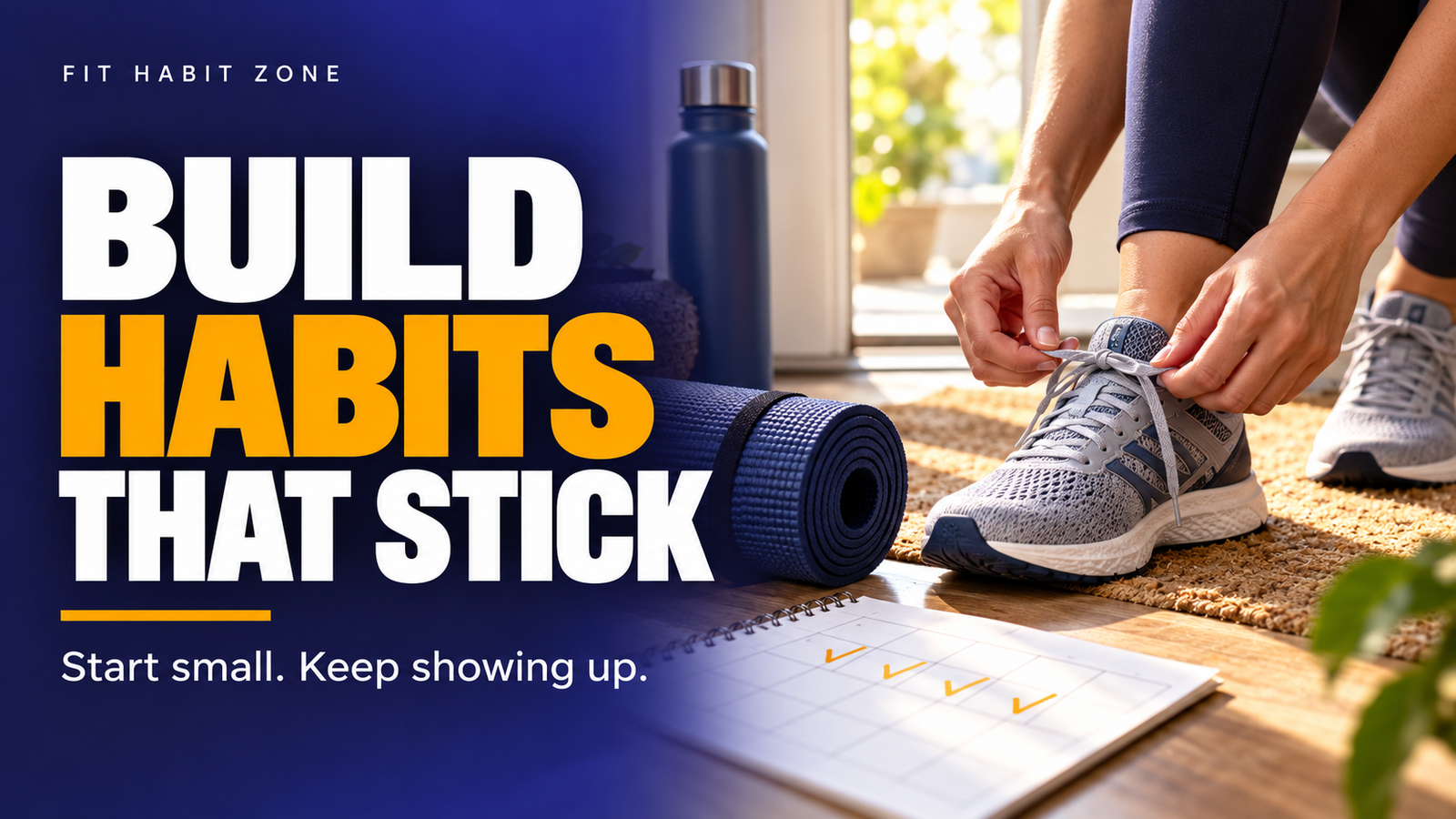
Your surroundings vote on your behavior all day. If your workout shoes are buried in a closet and your couch faces the television, the couch wins most evenings. Flip that friction: put your shoes by the door, lay out workout clothes the night before, and keep a mat where you can see it. Each of these removes one small decision between you and the workout.
Friction works in both directions. If your phone pulls you onto the couch, charge it in another room while you train. You do not need a perfect home gym. You need the path to the workout to be slightly easier than the path to skipping it.
Plan for the bad day
Every habit plan needs a bad-day version. Travel, illness, a late meeting, or a rough night will interrupt your routine, and the difference between people who stick with exercise and people who quit is usually what happens next. The rule that works: never miss twice. One missed day is life. Two in a row is the start of a new pattern.
Keep a minimum version of your workout for low-energy days. If your normal session is thirty minutes, your minimum might be a ten-minute walk. That keeps the chain alive without demanding a heroic effort when you have nothing to give. And remember that rest is part of training, not a break from it: our guide to rest days explains why planned recovery helps you progress faster than grinding every day.
Track it in the simplest way possible
Tracking helps, but only if it takes seconds. A paper calendar with a big X on each day you train is enough. The growing chain of X's becomes its own motivation, and an empty day stands out in a way a vague memory does not. Apps work too, but avoid anything that asks you to log ten fields per workout. The moment tracking feels like homework, you will stop tracking, and then you will stop training.
Review your chain once a week. Ask one question: did I do what I planned as often as I planned it? If yes, keep going and consider adding a little more. If no, the plan is too big, not you too weak. Shrink it until you can hit it most weeks, then build from there.
A sample first four weeks
- Week 1: Ten minutes of walking after lunch, three days. Lay out workout clothes the night before on those days.
- Week 2: Same walk, four days. Add five minutes of stretching after one walk.
- Week 3: Swap two walks for a short bodyweight session. Our 20-minute no-equipment home workout is an easy fit here, and you can do half of it and still count the day.
- Week 4: Four sessions, mixing walks and bodyweight work, at a regular protected time.
Notice what is missing: no dramatic overhaul, no six-day schedule, no guilt. By week four you have about sixteen sessions behind you, and more importantly, you have evidence that you follow through. That evidence is what carries you through week five, when the novelty wears off and the habit has to stand on its own.
The habit is the win
So pick something small, attach it to a daily cue, make it easy to start, and protect the chain. When you miss a day, and you will, get back the next day without a lecture to yourself. That is not lowering the bar. That is how the bar stays up for years.
This article is for general information only and isn't medical advice. If you have a health condition or injury, check with a qualified healthcare professional before starting a new exercise routine.