You Wake Up Stiff. That Doesn't Mean Something's Wrong.
Waking up feeling like a rusty hinge is one of the most common adult experiences — and one of the most misunderstood. Overnight, your body barely moves for hours, your muscles cool down, and the fluid that cushions your joints redistributes. The result is that creaky, tight feeling during the first few minutes of the day. For most people, it's normal, not a sign of damage.
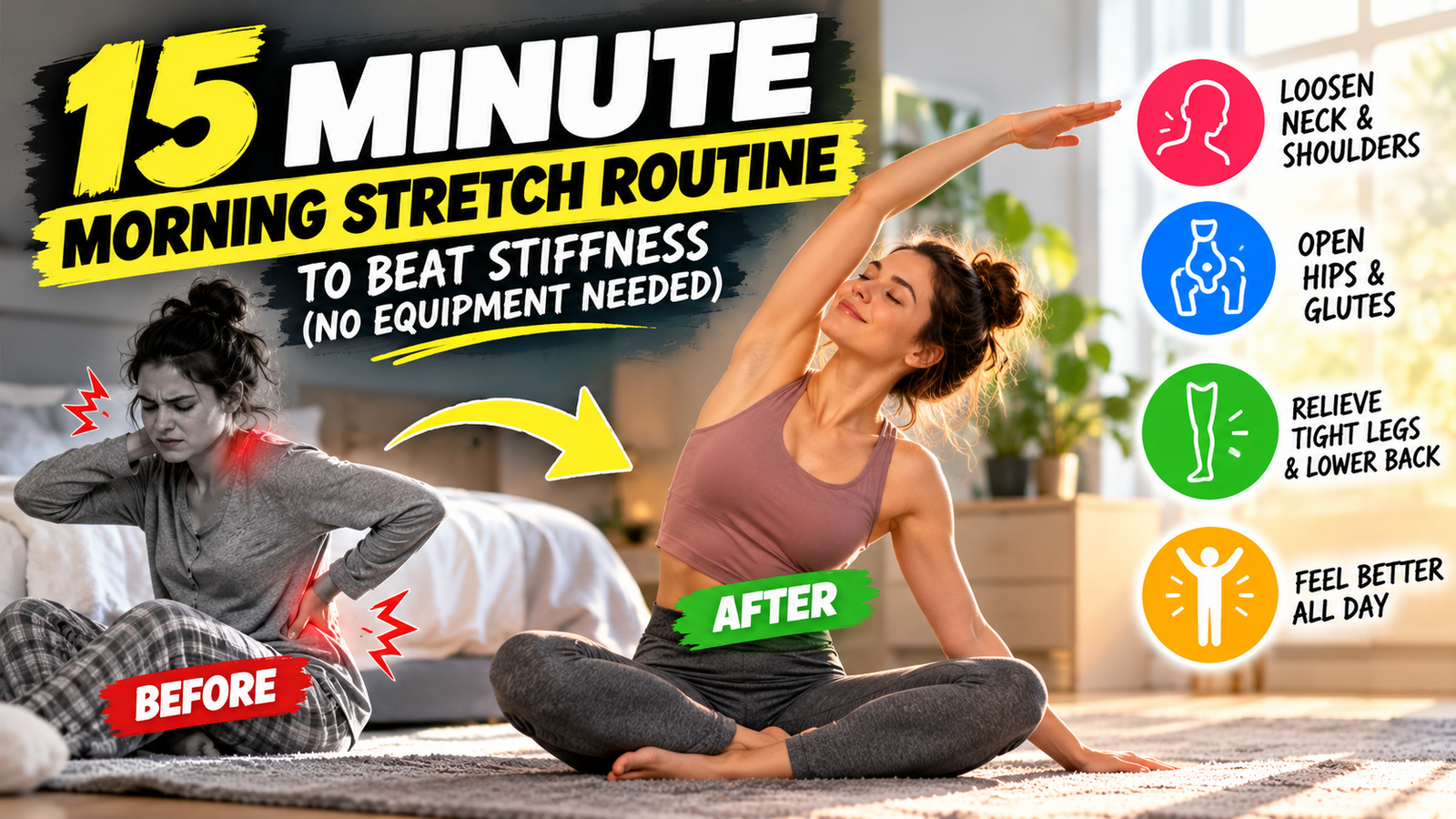
What matters is what you do about it. Fifteen minutes of gentle stretching each morning can ease that stiffness and improve how you move for the rest of the day. No gym, no equipment, no starting flexibility required. This routine was built for stiff bodies: every move below has an easy version, and the easy version is the right one on day one.
How to Use This Routine
Each section below takes three to four minutes, running in order from head to toe. Move slowly — this is not a workout. Hold each position for 20 to 30 seconds per side, breathing deeply the whole time. Never bounce: bouncing tells your muscles to tighten up, the opposite of what you want. Sharp pain is a stop sign — a mild pulling sensation is fine, pain is not. The corner of your bedroom works perfectly: a rug or bare carpet is all the equipment you need.
Minutes 0–4: Neck, Shoulders, and Upper Back
Start standing, or sitting on the edge of your bed. These four moves target the areas that tighten first overnight: the neck from the angle your pillow held it, the shoulders from sleeping curled up, the upper back from yesterday's desk slump.
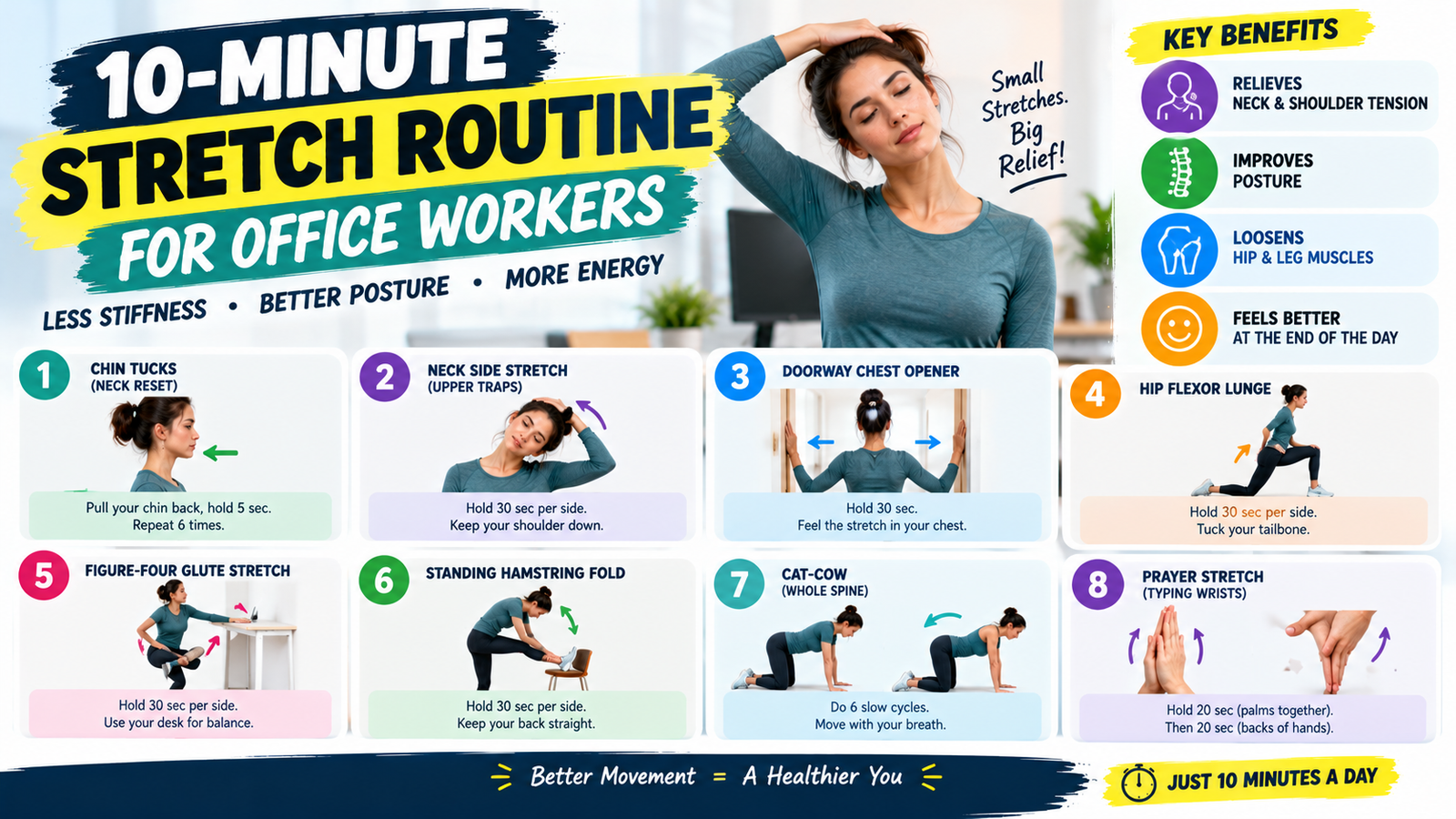
- Chin tucks — 5 reps. Pull your chin straight back like you're making a double chin, hold two seconds, release. This counteracts the forward-head creep that hours of screen time create.
- Ear to shoulder — 30 seconds each side. Tilt your head so your right ear drifts toward your right shoulder, keeping the opposite shoulder relaxed and down. A little gentle hand pressure on the head adds depth; skip it if it already feels like enough.
- Shoulder rolls — 10 each direction. Big, slow circles: lift, squeeze back, drop, and let the shoulder blades slide across your back. Ten forwards, then ten backwards.
- Standing cat-cow — 1 minute. Hands on your thighs, round your back like an annoyed cat as you exhale, then arch gently and look slightly up as you inhale. Ten slow cycles loosen the entire spine.
Minutes 4–8: Hips and Glutes
Move to the floor for this section. Your hips spend all day folded at a desk and all night folded in bed, so it's no surprise they're the tightest joint in the morning. These three stretches open them back up.
- Kneeling hip-flexor stretch — 30 seconds each side. Step your right foot forward into a lunge with your left knee on the floor (pad it with a folded towel if it's sore). Tuck your tailbone slightly under and shift your weight forward until you feel a stretch in the front of the left hip, keeping your chest upright.
- Figure-four stretch — 45 seconds each side. Lie on your back, cross your right ankle over your left knee, and gently pull the left thigh toward your chest. You should feel the stretch deep in the crossed leg's glute, where most desk-sitters store their tension.
- Supine twist — 30 seconds each side. Arms out in a T, knees bent, let both knees drop slowly to the right while your shoulders stay on the floor. Exhale as they fall — the twist loosens the mid-back too.
Minutes 8–12: Hamstrings, Calves, and Lower Back
The backs of your legs and your lower back work as a team, and tight hamstrings are a common reason people feel a pull behind their knees when they bend over.
- Standing hamstring stretch — 30 seconds each side. Prop your heel on a low step or a sturdy chair seat, keep the leg straight but not locked, and hinge forward from the hips with a flat back until you feel the pull behind the thigh. Bending the knee is fine at first — you'll straighten it over the coming weeks.
- Calf stretch on a step — 30 seconds each side. Stand with the ball of your foot on the edge of a step and let your heel sink below it. No step handy? Face a wall, hands on it, back leg straight, heel pressed into the floor.
- Child's pose — 1 minute. Knees wide, big toes touching, arms reaching forward on the floor. Finish with five slow, deep breaths and let your whole body go heavy.
Minutes 12–15: A Full-Body Finish
Stand up and link the whole chain together with three final moves.
- Doorway chest opener — 30 seconds. Place both forearms on a doorframe with your elbows near shoulder height, step one foot through the doorway, and lean gently forward. Your chest and the fronts of your shoulders get the stretch they missed all week.
- Standing forward fold — 45 seconds. Feet hip-width apart, fold at the hips, and let your arms dangle. Bend your knees generously — the goal is to relax the spine, not to touch your toes.
- Overhead reach and side bend — 30 seconds each side. Interlace your fingers overhead and push up tall, then lean gently to one side. Notice how the entire side of your body wakes up — ribs, waist, and hip all at once.
Making It Stick Past Week One
Morning routines survive on low friction. Lay out a rug the night before — or just use the bedroom floor, which needs zero setup. Pair the routine with something you already do: right after brushing your teeth, right before the shower, or while the coffee brews. It takes less time than scrolling your phone.
Expect the first three days to feel awkward. By the end of week one, the routine feels shorter as your body warms up faster. And if mornings genuinely don't work, this same sequence works fine as an evening wind-down.
The Simple Takeaway
Stiffness isn't a life sentence, and you don't need an hour of yoga to fight it. Fifteen minutes, a few stretches, and consistency will change how your body feels at 8 AM. Start with the gentle versions, don't chase pain, and give it two weeks.
This article is for general information only and isn't medical advice. If you have a health condition or injury, check with a qualified healthcare professional before starting a new exercise routine.