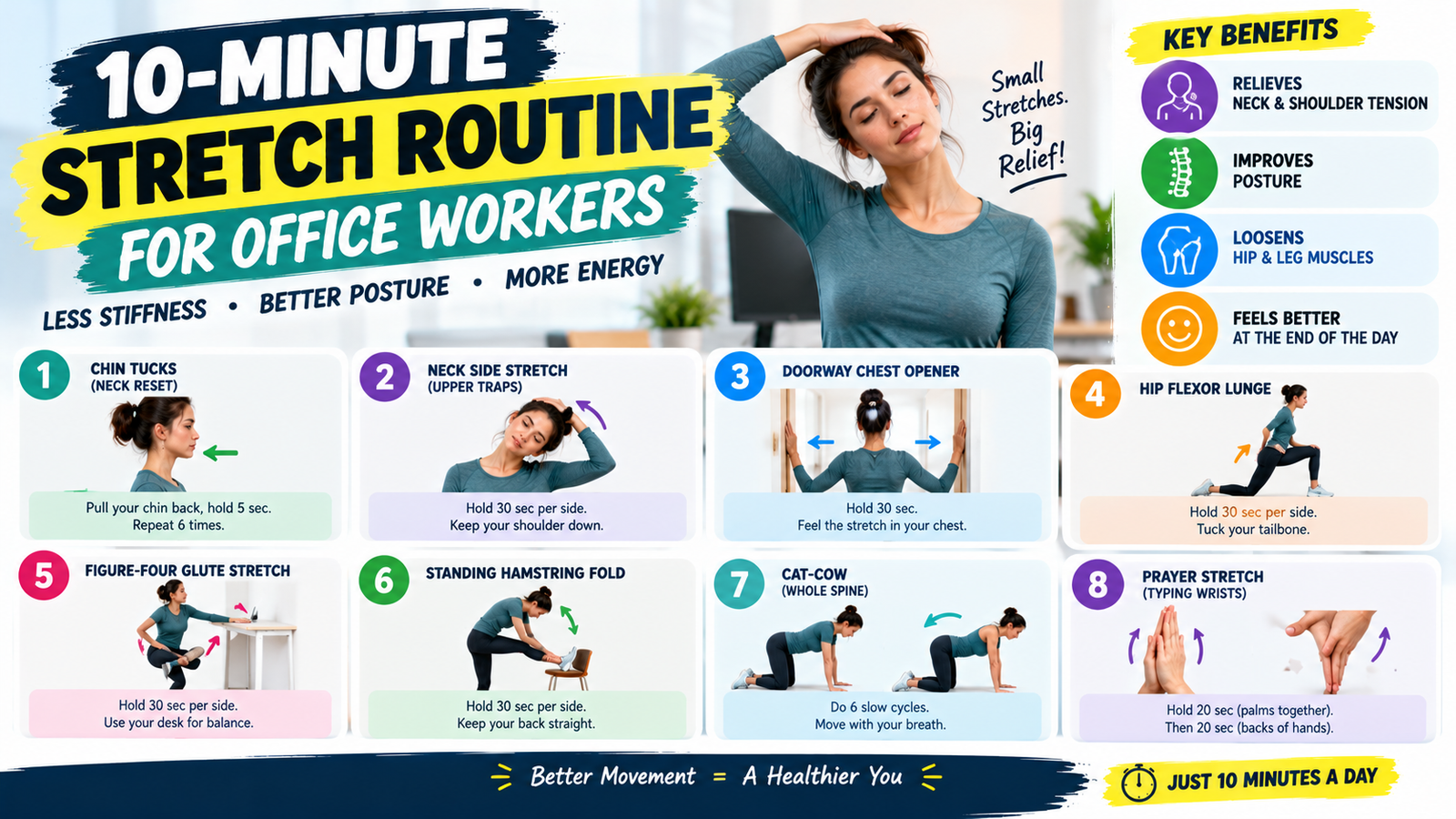
Let us be honest first: ten minutes of stretching cannot fully erase eight hours of sitting. Sitting still is the real problem, and only moving more during the day fixes that. But stretching is the second-best thing you can do, because sitting tightens very specific muscles — the front of the neck, the chest, the hip flexors, and the hamstrings — and a short daily routine aimed at exactly those spots can leave you feeling noticeably looser, with less neck ache and fewer stiff hips at the end of the day.
This routine needs no mat, no equipment, and no floor space. You can do the whole thing standing next to your desk. Hold each stretch about 30 seconds per side, breathe slowly the whole time, and stop at mild tension — never push into sharp pain.
1. Chin Tucks (the Neck Reset)
The classic desk-job neck is the "forward head": chin juts toward the screen, and the small muscles at the base of the skull work overtime. Chin tucks wake up the deep muscles that pull your head back over your spine. Sit or stand tall, look straight ahead, and draw your chin straight back — like you are making a double chin on purpose. Hold for 5 seconds, release, and repeat 6 times. It looks silly. It works.
2. Neck Side Stretch (Upper Traps)
Those heavy shoulders at the end of a long day are usually the upper trapezius muscles protesting. Sit tall, let your right shoulder drop away from your ear, and gently tilt your left ear toward your left shoulder until you feel a stretch down the right side of your neck. Hold 30 seconds, then switch sides. Keep the shoulder down — hiking it up toward the ear kills the stretch.
3. Doorway Chest Opener
Typing pulls your shoulders forward and rounds your upper back for hours. Find any doorway, place both forearms flat on the frame at shoulder height, and step one foot through until you feel a stretch across the front of your chest and shoulders. Hold 30 seconds. Your posture will feel visibly taller afterward — that is your chest muscles finally letting the shoulders sit back where they belong.
4. Half-Kneeling Hip Flexor Lunge
Sitting shortens the hip flexors — the muscles at the front of the hip that lift your thigh — because they spend all day in their shortest position. This is the single most important stretch on the list. Kneel on one knee with the other foot flat in front (a chair back is fine for balance), tuck your tailbone slightly under, and shift your hips forward until you feel a deep stretch at the front of the back hip. Hold 30 seconds per side.
5. Figure-Four Glute Stretch
Sitting on your glutes all day both compresses and weakens them, and tight glutes often show up as lower-back soreness by evening. Stand facing your desk, place your right ankle on your left knee to make a figure-four shape, and sit your hips back like you are lowering into a chair. You will feel the stretch deep in the right glute. Hold 30 seconds per side. Holding the desk for balance is completely fine.
6. Standing Hamstring Fold
Your hamstrings also sit in a shortened position for hours, which is why they feel like guitar strings when you finally stand up. Place one foot on a low step, chair seat, or the bottom stair, keep that leg straight with toes pointing up, and hinge forward at the hips until you feel a pull behind the thigh — not behind the knee. Hold 30 seconds per side. A slight bend in the standing knee is fine.
7. Cat-Cow (Whole Spine)
Stand with your knees slightly bent and hands on your thighs, or get on hands and knees if you prefer. Slowly round your back upward like an angry cat, tucking your chin, then reverse into a gentle arch, looking forward. Move with your breath — inhale on the arch, exhale on the round. Do 6 slow cycles. This wakes up the whole spinal chain that stiffens when you sit frozen in one position all day.
8. Prayer Stretch (Typing Wrists)
Forearms and wrists rarely make the stretching list, but for anyone typing all day they are working muscles. Press your palms together in front of your chest, fingers pointing up, and slowly lower your hands toward your waist while keeping the palms pressed — you will feel it in the underside of the wrists. Hold 20 seconds. Then flip: backs of the hands together, fingers pointing down, and raise gently. Hold 20 seconds.
The 10-Minute Sequence
Done in the order above, the math works out cleanly: the six single stretches and the two 30-second wrist holds take about a minute each, plus a minute of cat-cow, totaling roughly ten minutes. If you are short on time, the non-negotiable three are the chin tuck, the hip flexor lunge, and the hamstring fold — those cover the muscles sitting shortens most aggressively. Consistency beats duration here: ten minutes five days a week will do far more for your body than one heroic thirty-minute session on Sunday.
When to Do It — and How to Breathe
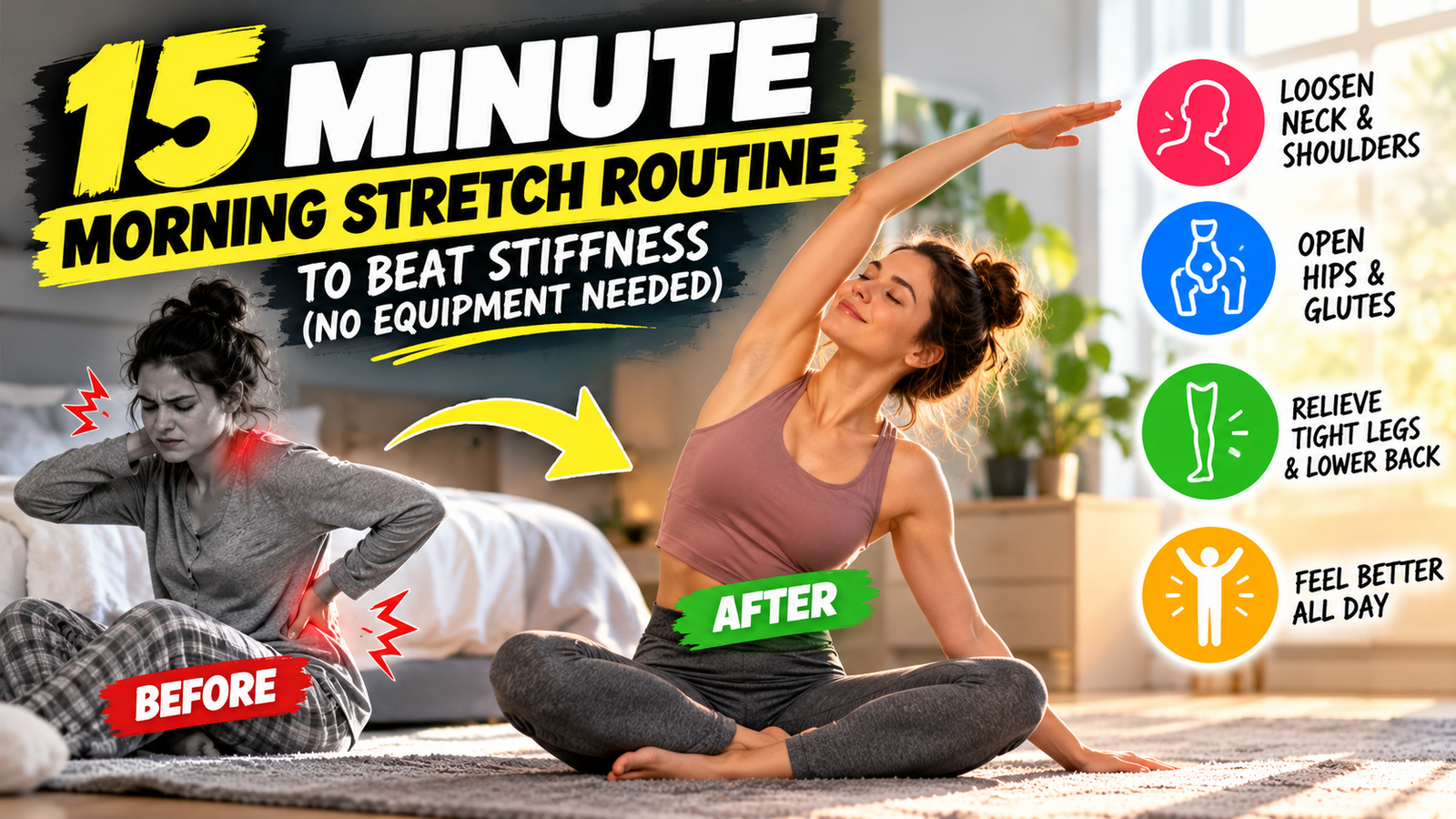
The best time is the end of the workday, when everything is tightest and a routine signals your body that desk time is over. A morning version works too — pair this routine with our 15-minute morning stretch routine for stiff bodies and you have the day bookended.
Breathe slowly and through your nose during every hold. Never bounce or force a stretch deeper on an exhale than your body allows — the muscle should relax into the position, not be yanked there. If you are unsure what that rhythm feels like, our guide to breathing properly when you exercise walks through the basics that apply just as well to stretching.
Stretching Is the Bandage — Movement Is the Fix
This routine treats the symptoms, and that is genuinely worth doing. But the deeper fix is sitting less, not stretching more: stand and walk for two minutes every hour, take calls on your feet, drink water so refilling the glass becomes a reason to move. Once the 10-minute routine feels easy, the natural next step is adding real movement — our 20-minute no-equipment home workout picks up exactly where this routine leaves off, no gym required.
This article is for general information only and isn't medical advice. If you have a health condition or injury, check with a qualified healthcare professional before starting a new exercise routine.